Flat Roofing in Holland Township from $5. $5 to $14 a square foot, and out here it is nearly always a later addition to something older. Free inspection and a written quote.
On farm properties the low-slope areas are usually utilitarian: a lean-to against a barn, a milk house, a modern addition to an old house. They are simple to re-cover and the failure is nearly always where they meet the older building beside them.
Flat roofing installs at $5 to $14 per square foot, EPDM at $5 to $9 and TPO at $6 to $12. Almost none of it out here is original: it is a rear extension, a porch roof, a breezeway or a lean-to added to a building that predates the idea of a flat roof entirely.


Flat roofing installs at $5 to $14 per square foot: EPDM at $5 to $9 and TPO at $6 to $12. Almost none of it here is original -- it is a later addition to a building that predates the idea, so the junction with old masonry is the job. A property here frequently means several roofs, and surveying them in one visit is cheaper than three separate call-outs months apart. House and outbuildings are priced separately because they are genuinely different work, but they are looked at together.
A simple rectangle with a real fall, at accessible height, on a conventional later house.
An upstand against stone or rubble wall, where there is often nowhere obvious to terminate and somebody has previously solved it with sealant. Sealant is a finish, not a fixing, and it is the commonest failure on this kind of roof.
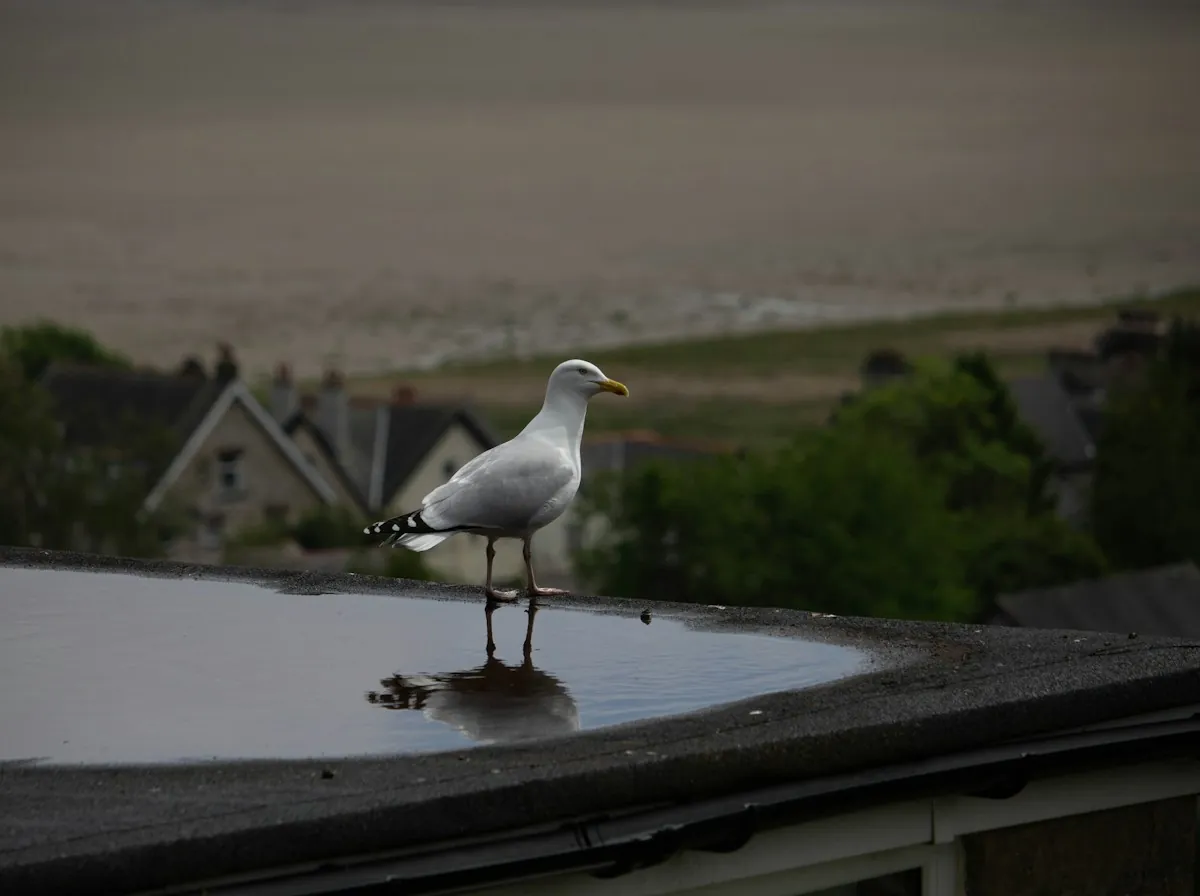
Water that clears within a day or two is normal. Water still there a week later means the fall does not run where somebody said it did, and that seam is being tested continuously.
This is barn country, and a property here frequently means more than one roof. The house and the outbuildings are different jobs with different economics, and surveying them together in one visit is both cheaper and more useful than treating them as separate inquiries.
Where a property has several buildings, doing the roofs in a sensible order matters more than doing them all at once.
The first two are the ones a suburban roofer working out here for the first time will struggle with.
A roofer who answers 'the roof is shot' without distinguishing those is either guessing or selling. The difference is a factor of five or more in price.
Nobody knows how much deck has softened until the covering is off. A rate per sheet is honest; a lump sum gets revisited upwards once the roof is open.
New Jersey registers home improvement contractors and the number belongs on the paperwork, not just a website footer. Its absence tells you something before you have read a price.
A property here frequently means more than one roof -- the house, and then a barn, a shed or a wagon house behind it.
Out here the honest question is whether one visit can do it.
Exposed-fastener panel over purlins is the normal answer on working buildings and has been for a century.
This is barn country and a barn roof is not a big house roof.
Farmhouse slate is frequently on a frame built to carry it, which makes stone-for-stone a genuine option rather than a structural project.
Farm buildings are often ungutted entirely, and sometimes that is fine -- a barn on well-drained ground away from anything does not necessarily need one.
A survey here covers the house and the outbuildings, and on the outbuildings it happens from inside.
An old river town. Find out what is really up there.
Two centuries of building, scattered widely.
The biggest roofs here. Price the frame first.
Town roofs again, where access is the hard part.
Asked on every job of this kind. Answered here.
Not in itself. Water that clears within a day or two of rain is normal. Water still there a week later is a seam being tested continuously, and it usually means the fall does not run where somebody said it did.
Because it has probably been terminated with sealant rather than properly formed and fixed. On old masonry there is often nowhere obvious to tuck an upstand into, so somebody reaches for a tube. Sealant is a finish, not a fixing, and it is the commonest failure on this kind of roof out here.
Usually not, on a house. Replacing the roof COVERING on a detached one- or two-family dwelling is ordinary maintenance under N.J.A.C. 5:23-2.7 -- no permit, no notice, no inspection. Out here there is a second question that does not arise elsewhere: an agricultural building is a different case, and the answer depends on what it is used for. That gets asked of the township rather than assumed from a website, and each of the five municipalities in this service area has its own construction office.
It depends far more on the material than on the state, and out here the materials are not all asphalt. Architectural asphalt typically gives 20 to 30 years and three-tab 15 to 20. Standing seam metal commonly gives 50 and more. Exposed-fastener panel gives a long life too, but its screws and washers are consumables and want re-tightening -- a panel roof nobody has touched in 25 years is on borrowed time at its fixings rather than in its sheets. Natural slate outlasts all of them, frequently by a century, which is why so much of it around here needs nails rather than stone.
For a standard asphalt roof on an average house, yes -- that is well above the $12,000 to $18,000 most land at. For a large barn it can be entirely normal, because a barn roof is enormous even though the rate per square foot is the lowest of anything we do. And for natural slate at $22 to $35 a square foot it is unremarkable. The number on its own answers nothing; what the quote itemizes does.
What is actually under the covering, established before a price. The frame surveyed from inside on any farm building.