Roof Replacement in Alexandria Township from $9,500. $12,000 to $18,000 on a typical house -- and a different conversation entirely if the building predates the twentieth century. Free inspection and a written quote.
The widest spread of building ages in this service area, which makes assuming anything a mistake. A stone farmhouse and the house built on the next parcel in 1998 need entirely different surveys, and around here they are sometimes owned by the same person.
An architectural asphalt roof in New Jersey runs $9,500 to $26,000, with most 2,000 square foot houses landing at $12,000 to $18,000 installed. Architectural shingle is $5.50 to $8.00 per square foot against $4.50 to $6.50 for three-tab.


New Jersey figures for an architectural asphalt roof, with most 2,000 square foot houses landing at $12,000 to $18,000. Those numbers describe a suburban house, and a good share of what we replace out here is an older farmhouse where the first question is what is actually under the visible covering. Scattered settlement means real distance between jobs, so batching work within the township genuinely brings prices down and we will say when it applies. Building ages here span two centuries, so nothing is assumed from what the neighbors have.
A simple roof shape, good access, one existing layer, and a deck that turns out sound. The later housing on subdivided land out here usually qualifies.
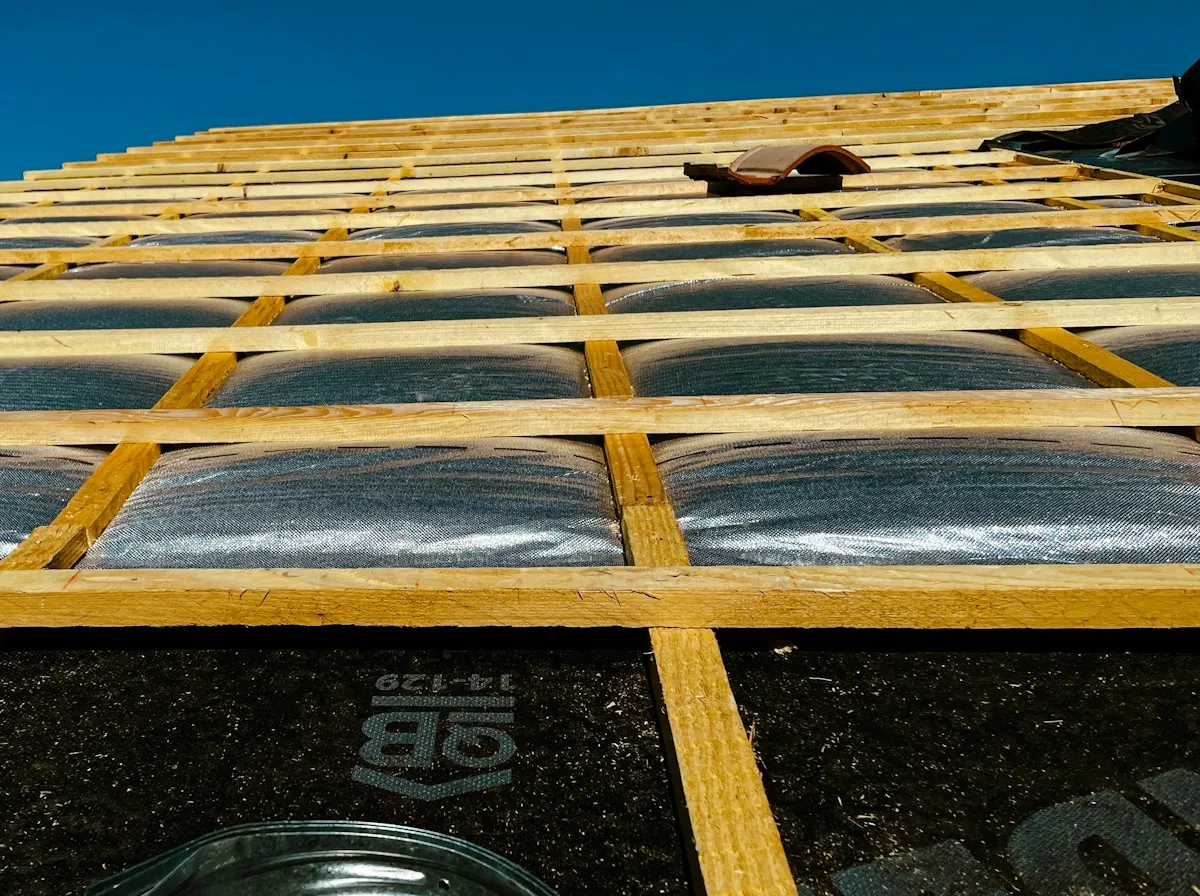
Surprises under the covering -- slate or standing seam that somebody roofed over decades ago, board sheathing that has to be made good, a second and sometimes third layer. On old buildings none of this is visible until it is.
How decking replacement is priced. It belongs in the scope as a rate per sheet, because nobody knows how much has softened until the covering is off.
The widest spread of building ages in this service area, which makes assuming anything a bad idea. A stone farmhouse and the house built on the next parcel in 1998 need entirely different surveys, and they are sometimes owned by the same person.
Scattered settlement means real distances between jobs, which is exactly why batching visits in a township is worth doing.
None of them appear in a national cost guide, and all three can move a number by an order of magnitude.
On housing this age, asphalt laid over standing seam or slate in the 1970s is common and nobody has been up since. That changes the tear-off, the disposal, the deck condition and the right replacement -- so it is established before a price rather than discovered on the second morning.
Natural slate outlives its nails and its valley metal by a long way. A roof shedding tiles is most often sound stone on failed fixings, and renailing with the slate reused costs a fraction of new slate at $22 to $35 a square foot. Getting this wrong in the wrong direction costs tens of thousands.
Milford Borough is a square mile and a quarter; the service area is four townships. Travel is a real cost on a small job. We would rather name it, and batch visits where it makes sense, than put it in a rate where you cannot see it.
Scattered settlement means real distance between jobs, so we will say openly when batching your repair with other work in the township would bring the price down.
With building ages this varied, the metal question splits cleanly: standing seam suits the older houses where it was probably original, panel suits the outbuildings, and on a 1990s house metal is a genuine choice rather than a restoration.
Former farms mean barns that are no longer used as barns, and that changes the brief.
With this range of ages, the first thing a slate survey settles is whether the roof is original slate or a later replacement, because those age very differently.
Later houses here have conventional flat additions that behave conventionally, and older ones have additions built against stone.
On sloping rural plots the question that matters is not the gutter but where the downspout discharges.
With building ages this varied the inspection has to start without assumptions.
An old river town. Find out what is really up there.
Barn country. A property is usually several roofs.
The biggest roofs here. Price the frame first.
Town roofs again, where access is the hard part.
Asked on every job of this kind. Answered here.
Only where it has actually softened, and as a rate per sheet in the written scope rather than a lump guess. On the older buildings here the deck is frequently board sheathing rather than plywood, which holds a nail differently, so it is established by lifting and looking before anything is specified on top of it.
Only over one existing layer, on a sound deck -- and on an old building there is a better reason to strip. An overlay hides whatever is underneath, and what is underneath out here is quite often standing seam or slate that somebody roofed over decades ago. You want to know that, not bury it deeper.
It depends far more on the material than on the state, and out here the materials are not all asphalt. Architectural asphalt typically gives 20 to 30 years and three-tab 15 to 20. Standing seam metal commonly gives 50 and more. Exposed-fastener panel gives a long life too, but its screws and washers are consumables and want re-tightening -- a panel roof nobody has touched in 25 years is on borrowed time at its fixings rather than in its sheets. Natural slate outlasts all of them, frequently by a century, which is why so much of it around here needs nails rather than stone.
For a standard house, $12,000 to $18,000 covers most 2,000 square foot properties, within a full range of $9,500 to $26,000. The more useful answer for this area is that you cannot price an old building from a published range at all, because the number turns on things nobody can see from the road: what is under the covering, how many layers, whether the deck is boards, and whether the frame was built for the weight of what is on it.
In architectural asphalt, roughly $6,600 to $9,600 on New Jersey rates. But watch the units: 1,200 square feet of FLOOR is not 1,200 square feet of roof. Pitch, overhangs and dormers commonly make the roof area a third larger, and on a steep old farmhouse the difference is bigger still. That single confusion explains most quotes that look inexplicably far apart.
What is actually under the covering, established before a price. The frame surveyed from inside on any farm building.